Bungee Jumping vs Skydiving
Tuesday, February 24, 2026
- Andy Odom
- 2/24/26
- 0
- Skydiving Information
TL;DR
Skydiving and bungee jumping share key similarities, including intense adrenaline, specialized equipment, supervision, and reliance on height and gravity. However, they differ significantly in age requirements, freefall duration, training time, physical sensations, and oversight. Many people find skydiving less scary because it includes varied phases – plane ride, freefall, canopy flight, and landing – rather than the continuous intensity of a bungee jump.
Skydiving and bungee jumping are both extreme activities that have a lot of similarities – and also stark differences! Let’s take a deeper dive to help you determine which one is better for you.
Skydiving vs Bungee Jumping: The Similarities
First things first, let’s consider the attributes skydiving and bungee jumping share.
Extreme Adrenaline
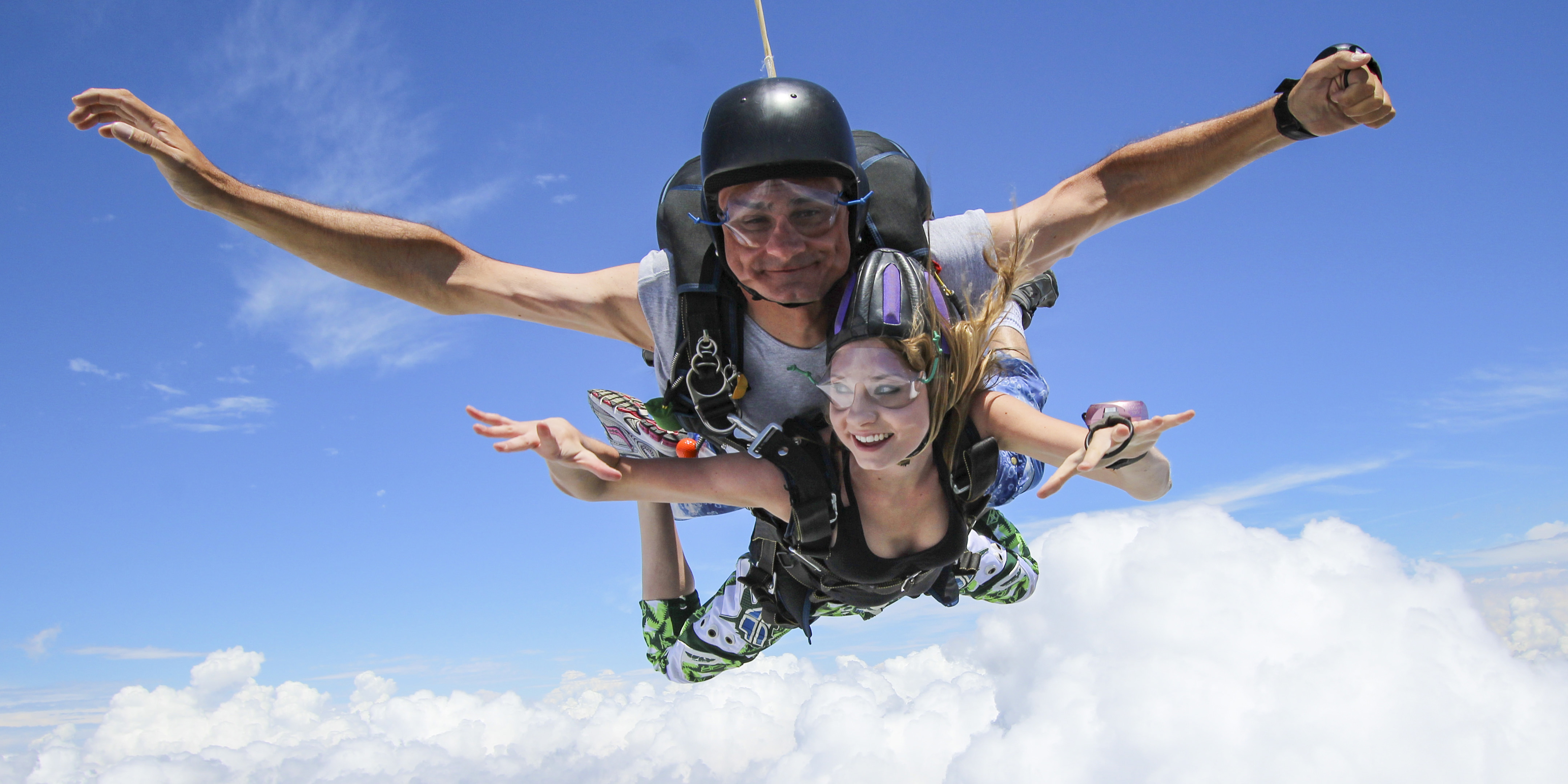
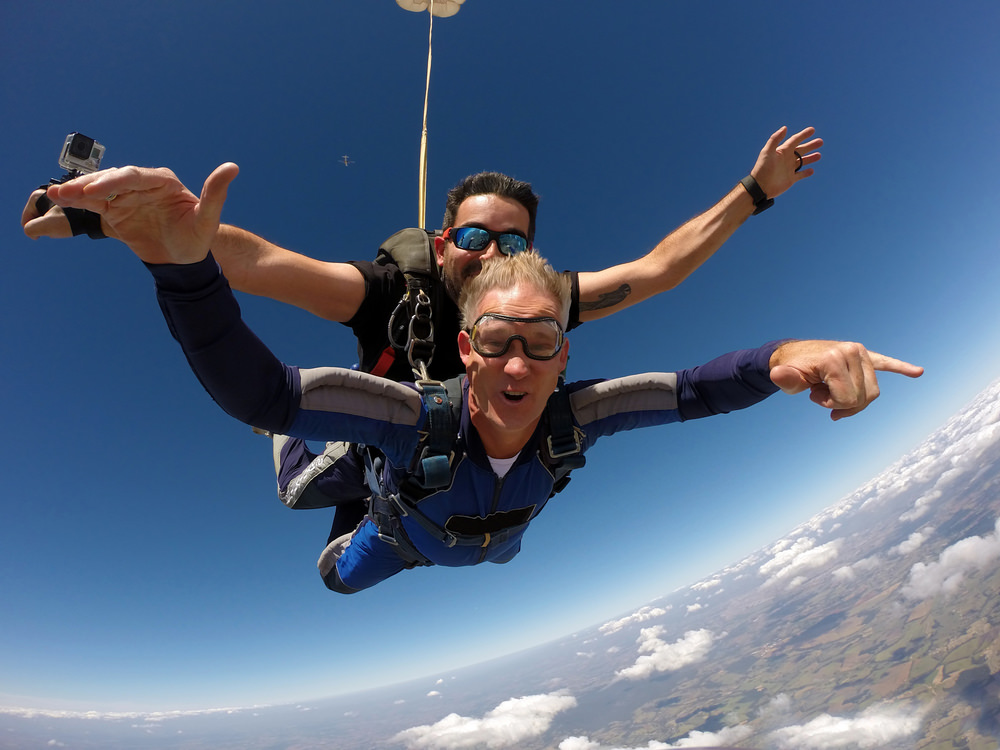
Skydiving for the first time entails jumping from an airplane with nothing but a highly trained instructor, a parachute, and some really big guts! Bungee jumping is when you willingly leap from a platform, harnessed to what is essentially a ginormous rubber band – AH! Both of these activities would get anyone’s blood pumping.
Specialized Equipment
Due to the extreme nature of skydiving and bungee jumping, both require specialized equipment.
Supervision
Although skydiving is a bit more involved (you can’t fly a parachute on your own without any guidance!), both activities rely on trained professionals to brief participants.
Note, skydiving is heavily regulated. Tandem skydiving instructors are certified professionals who have hundreds or thousands of jumps, hundreds of hours of freefall time, and extensive on-ground and in-air instruction. Bungee jumping does not have federal oversight and certification requirements are not standardized. More on this later.
Height-Based
Both skydiving and bungee jumping rely on gravity and falling from a height way above the ground.
 Skydiving vs Bungee Jumping: The Differences
Those unfamiliar with both extreme activities may think skydiving and bungee jumping have more in common than not, but the differences outnumber the similarities by far!
Age Requirement
The standard age requirement to skydive in the United States is 18 years old. Here, this is considered to be the age of majority for most activities – such as voting, joining the military, and getting a tattoo. The age requirement for bungee jumping is more lax, and can be as low as 14 years old.
Launch Point
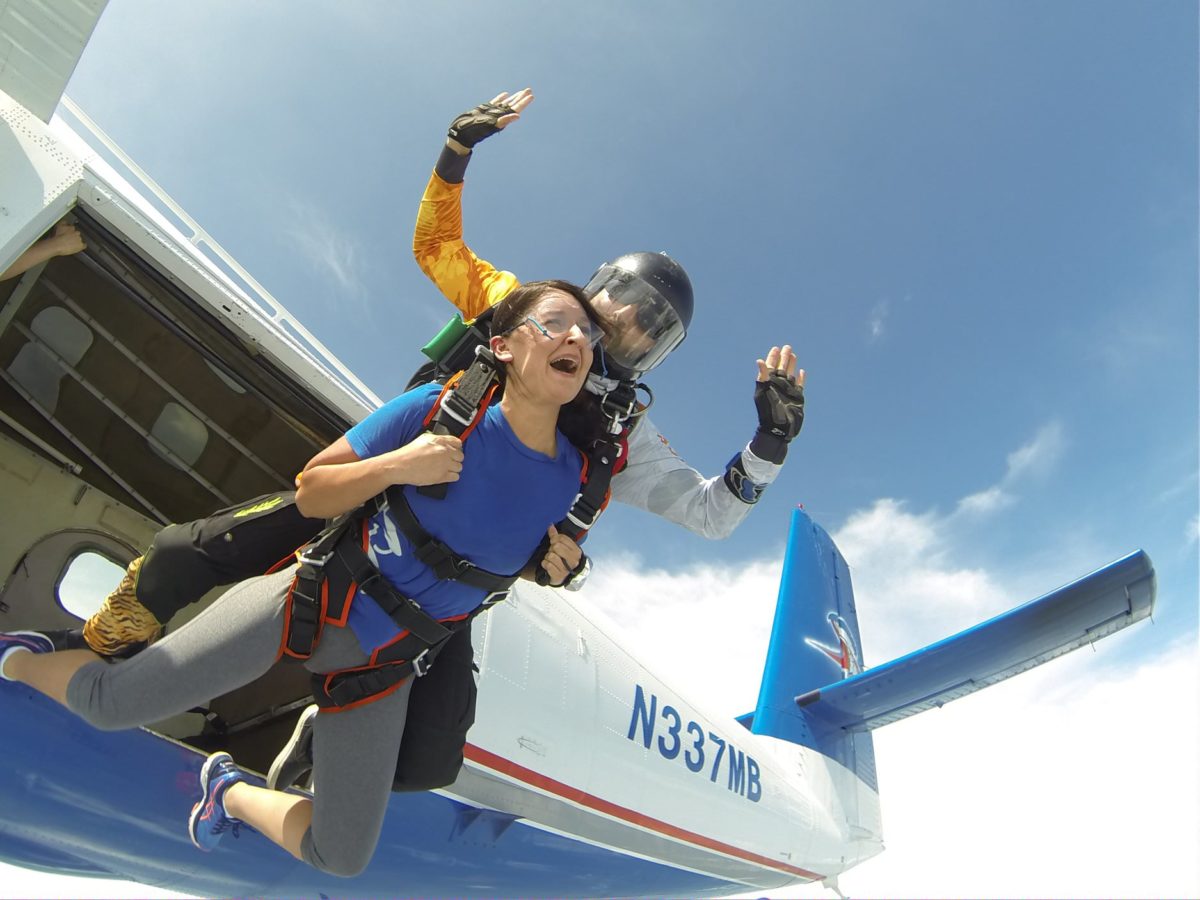
Skydiving, of course, happens in the sky. To gain access to that kind of altitude, we hitch a ride in some sort of aircraft – an airplane most frequently, but also helicopters and hot air balloons. Bungee jumpers leap into the air from a fixed object, oftentimes manmade – like a bridge or platform. Which brings us to the next point …
Stomach-Drop Sensation
What does bungee jumping feel like compared to skydiving? When you leave from a static object – as with bungee jumping and BASE jumping – you experience a sort of “0 to 100” velocity rush, which causes the stomach drop sensation in your stomach.
With skydiving, you exit from a moving object that’s often already traveling super fast. When the object you are exiting from is already moving rapidly, the stomach drop feeling doesn’t occur!
Average Height
Skydiving typically takes place between 10,000 and under 15,000 feet. Bungee jumping takes place between 150 and 300 feet.
Freefall Duration
When you bungee jump, you go up and down and up and down multiple times. These repetitive movements take a few minutes, which is similar to how long a skydive takes. However, the initial WHOOSH of a bungee jump is only about 5 seconds, whereas skydiving freefall is 30 to 60 seconds or more, depending on the altitude you jump from. (At Skydive Orange, you’ll exit from 13,500 feet and enjoy about 60 seconds of glorious freefall.)
Physical Impact of Deceleration
One reason many avid skydivers swear against going bungee jumping is the recoil of the bungee cord. With skydiving, deceleration is gradual – shifting from 120 mph to about 20 mph over a matter of seconds as parachute deployment occurs. Skydivers feel “lifted,” whereas bungee jumpers feel “snapped back.”
Cost
Just like skydiving, bungee jump costs vary by location. A skydive above a volcano in Bend would be more pricey than the same type of jump over the beautiful plains of Texas, and bungee jumping works the same way. Skydiving prices range from about $200-$400, while bungee jumping jumping ranges from about $80-$300.
Training Time
The training time for a student participating in a tandem skydive lasts around 30 minutes, and multiple hours for those preparing for their first solo skydive. The safety briefing for a bungee jumping experience only takes about 5 minutes.
Participant Count
Tandem skydiving, as the name suggests, involves two people – an instructor and a student (you). The instructor takes care of all of the mechanics and logistics, and you primarily enjoy the ride (although, you do play an active role at certain points). With bungee jumping, you’re on your own.
Oversight
In the US, skydiving operates under a structured combination of federal regulation and industry governance. The Federal Aviation Administration (FAA) regulates the aircraft, pilots, airspace, and parachute equipment, including requirements for certificated parachute riggers. In addition, the United States Parachute Association (USPA) sets comprehensive safety standards, training programs, instructor ratings, and operational best practices for member drop zones nationwide.
Bungee jumping, by contrast, does not fall under a single US federal regulatory body – there is no equivalent to the FAA overseeing operations nationwide. Instead, regulation typically occurs at the state or local level, where bungee operations are often classified as amusement rides or special attractions and may require permits, engineering approvals, and periodic inspections. Oversight standards vary significantly, and many operators rely on internal training programs and voluntary industry guidelines rather than a unified national governing organization.
Bungee Jumping vs Skydiving: The Differences
| Feature | Tandem Skydiving | Bungee Jumping |
| Adrenaline Intensity | High | High |
| Age Requirement in US | 18 Years Old | 14 – 16 Years Old |
| Launch Point | Aircraft | Fixed Object |
| Stomach Drop | No | Yes |
| Average Height | 10,000 – 15,000 feet | 150 – 300 feet |
| Freefall Duration | 30 – 60 seconds | ~5 seconds |
| Deceleration Impact | Gradual, Lift | Sudden, Snap Back |
| Cost | $200 – $400 | $80 – $300 |
| Training Time | 30+ minutes | ~5 minutes |
| Participants | 2 | 1 |
| Oversight | FAA, USPA | State, Local |
Why Is Skydiving Less Scary Than Bungee Jumping?
Why does skydiving feel less scary? It’s not because there’s less adrenaline or fear (we may argue that there’s more in skydiving)! Skydiving is generally deemed less scary than bungee jumping because there are different phases – the plane ride up to altitude, 60 seconds of blissful freefall, followed by several peaceful minutes under the parachute, and then an easy touch down landing. The bungee experience, on the other hand, is jam-packed with exhilaration the entire time – it’s go-go-go, and then done.
Let’s look at this question from a different angle: is bungee jumping safer than skydiving? It’s difficult to say – we have skydiving safety statistics that date back decades from the USPA, but no such data exists for bungee jumping. There is inherent risk in participating in both activities, with some reports suggesting that the risk is about the same. We cannot vouch for bungee jumping, but USPA statistics from 2024 show the fatality rate of skydiving to be 1 in 435,000 jumps, or 1 in 500,000 tandem jumps.
Skydiving also features more safety redundancies, which go a long way for peace of mind. Parachutes are inspected every single time they’re packed, and reserve parachutes are inspected and repacked every 180 days by an FAA-certified rigger. (Yep! We jump with two parachutes.) Plus, skydiving rigs are equipped with an AAD – a device designed to automatically deploy the reserve parachute if the jumper cannot.
Craving Adrenaline? Skydive!
It’s your decision, but if you ask us which is best, it’s skydiving all the way! Come find out for yourself! Book your jump today! Blue skies!

Dave Harris – South Riding, VA
South Riding, VA
The instructors and coaches were incredibly competent, professional and fun to be around.
The largest tandem skydiving center near Northern Virginia, Washington D.C. and Maryland.
Copyright © 2026, Skydive Orange, All Rights Reserved.
DropZone Web Design & Marketing by Beyond Marketing, LLC