How Was Skydiving Invented?
Tuesday, December 3, 2019
- Skydive Orange
- 12/03/19
- 0
- General
TL;DR
The history of skydiving spans centuries, from early parachute concepts to today’s recreational and competitive sport. Leonardo da Vinci created one of the best-known early designs, and André-Jacques Garnerin made a successful parachute descent in 1797. Advances in aircraft parachuting, military use, ram-air canopies, and improved equipment helped shape modern skydiving. Tandem skydiving, developed in the early 1980s, made the sport more accessible by allowing first-time jumpers to experience freefall with a trained instructor. Today, skydiving continues to evolve through new disciplines, equipment, training, and record-setting jumps.
Skydiving has become increasingly mainstream over the years, but the sport we know today looks very different from its earliest beginnings. Parachute design, training methods, equipment, and built-in redundancies have evolved significantly over time.
That doesn’t mean skydiving is safe. It is still a high-risk activity. But modern skydiving has come a long way from the experimental parachute jumps of centuries past.
So, what is the history of skydiving? Who invented skydiving? When did the first person go skydiving, and how did we get from early parachute concepts to modern tandem skydiving?
Let’s take a look.
When Did Skydiving Start?
There isn’t one definitive moment when skydiving was “invented.” Its history developed gradually, beginning with early ideas for slowing a person’s descent and eventually progressing to parachuting from aircraft and intentional freefall.
When was the parachute invented? Some reports trace parachute-like experiments as far back as China in the early 1100s. However, the more documented history of parachuting begins centuries later.
- 1483: Leonardo da Vinci sketched a pyramid-shaped parachute design demonstrating how air resistance could theoretically slow a person’s descent. Although there is no evidence that da Vinci built or tested it, his drawing is among the best-known early parachute concepts.
- 1797: French balloonist André-Jacques Garnerin made one of the first documented successful parachute descents, jumping from a hydrogen balloon approximately 3,200 feet above Paris.
So, who invented skydiving? It depends on how you define it. Da Vinci helped develop the concept of the parachute, while Garnerin demonstrated that a person could actually use one to descend from the sky. The sport itself would take another century, and the invention of the airplane, to begin taking shape.

From Parachuting to Freefall
The early 1900s brought another major change: parachuting from airplanes.
Charles Broadwick developed an early static-line system, in which a line attached to the aircraft initiated parachute deployment after the jumper exited. His adopted daughter and protégé, Georgia “Tiny” Broadwick, became another important figure in early parachuting.
- 1913: Tiny Broadwick became the first woman to parachute from an airplane.
- 1914: During demonstrations for the U.S. Army, Broadwick performed a manually deployed freefall jump, disconnecting the static line and deploying the parachute herself after leaving the airplane.
Now, a jumper could leave an airplane, fall independently, and then deploy the parachute. The concept of modern freefall skydiving was beginning to emerge.
Parachuting and the Military
Military use played a major role in developing parachuting equipment and techniques, particularly during the World Wars. Beyond serving as emergency equipment for aviators, parachutes allowed military forces to deliver soldiers, equipment, and supplies into difficult-to-reach areas.
Following World War II, surplus military equipment became more widely available, and former military parachutists helped transform parachuting from a military necessity into a recreational and competitive activity.
The Evolution of Modern Skydiving
By the middle of the 20th century, parachuting was becoming an organized sport.
- 1950s: Parachuting clubs formed around the world, while jumpers experimented with freefall formations, accuracy, and competition. The first World Parachuting Championships were held in 1951.
- 1960s: Domina Jalbert developed and patented the ram-air parafoil concept, which would revolutionize parachute design by providing far greater forward movement, steering, and landing control.
- 1970s and 1980s: Square ram-air parachutes became increasingly common, equipment continued to improve, and recreational skydiving grew. Modern container systems, reserve procedures, and other innovations helped shape the systems skydivers use today.
By this point, experienced jumpers could skydive recreationally, train, and compete. But learning to jump independently still required considerable training. That led to another major development.
When Was Tandem Skydiving Invented?
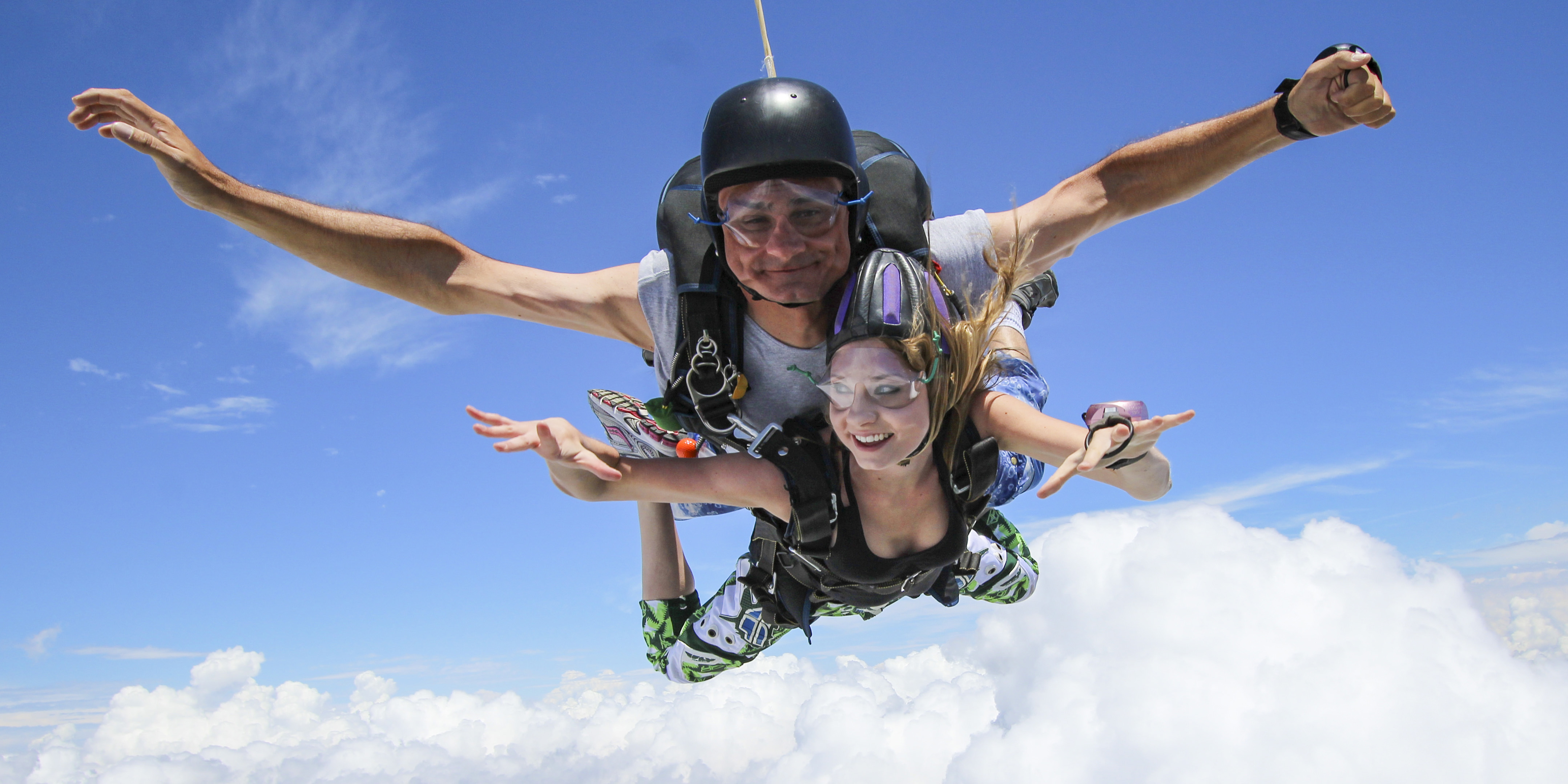
Tandem skydiving changed who could participate in the sport. Instead of learning to operate their own parachute system, a first-time jumper could be securely connected to a specially trained instructor who managed the critical components of the skydive.
In the early 1980s, equipment manufacturers Bill Booth and Ted Strong independently developed tandem parachute systems specifically designed to carry two people.
- 1983: Early jumps using purpose-built tandem systems demonstrated that an instructor and passenger could freefall and land together under one parachute system.
- 1980s: Tandem equipment and training continued to develop, and tandem skydiving spread throughout the sport under FAA exemptions.
- 2001: Tandem skydiving was formally incorporated into federal parachute regulations after years of operating under exemptions.
Tandem skydiving made the sport accessible to people who wanted to experience freefall without first completing extensive solo training.

How Skydiving Equipment Has Evolved
The parachutes used by early jumpers would be nearly unrecognizable compared with a modern skydiving system. Today’s equipment incorporates multiple layers of redundancy, typically including:
- A steerable ram-air main parachute
- A separately packed reserve parachute
- A three-ring release system that allows a malfunctioning main parachute to be disconnected
- An Automatic Activation Device (AAD), which can initiate reserve deployment under specific conditions
- Altimeters and other equipment that help skydivers maintain altitude awareness
Equipment is only one part of that evolution. Training standards, instructor qualifications, emergency procedures, aircraft operations and maintenance requirements have also developed alongside the technology.
Skydiving Today
Today, skydiving is an established recreational and competitive sport practiced around the world, with disciplines ranging from formation skydiving and freeflying to wingsuiting, canopy piloting and more.
For first-time jumpers, tandem skydiving has become one of the most common ways to experience the sport. It’s a long way from the experimental parachutes and balloon jumps of centuries past.
And the sport continues to evolve. Skydivers continue to develop new disciplines, advance equipment and training, and push the boundaries of what’s possible, including record-breaking jumps from the stratosphere. In other words, skydiving history is still being made.
At Skydive Orange, you can become part of that history. Come see for yourself why people have been fascinated by parachuting for centuries and become part of the story of skydiving. Book your skydive today!


Megan Kile
I would definitely recommend Skydive Orange to anyone wanting to jump!!!
The largest tandem skydiving center near Northern Virginia, Washington D.C. and Maryland.
Copyright © 2026, Skydive Orange, All Rights Reserved.
DropZone Web Design & Marketing by Beyond Marketing, LLC